


 January 2007 (A counterargument to the foreword to Jessica Livingston's Founders at Work.) Early startups often move remarkably quickly. With a tiny team, an idea can become a decision and then a product without passing through several departments. Imagine Apple when its employees were Jobs and Wozniak. But that phase is also small enough to hide costs in the founders' time and improvisation. Its apparent speed isn't a sufficient measure of productivity, and the sprinter analogy shouldn't encourage us to assume that every later organizational addition is a form of slowing down. The contrast with familiar business imagery is striking: suits, conference tables, presentations, and reports. Some of that activity is ceremonial. Some coordinates people who don't share a founder's memories or tacit assumptions. A report can look less productive than a burst of programming while preventing several teams from building incompatible things. Claiming that the least formal part of the economy is the most productive requires a measure of output and cost, rather than a convincing collection of images. The story of a car magazine stripping decorative parts from a sports model to improve its quarter-mile time illustrates the cost of useless ornament. Yet a specialized race also excludes requirements that ordinary drivers value. Passenger protection, comfort, repairability, and years of service aren't measured by the same stopwatch. In business, the corresponding question is which procedures merely decorate and which satisfy requirements absent from the founders' first experiment. Cutting everything that fails to improve a short sprint can damage the product that customers actually depend on. Founder interviews are useful because the successful ones remember the chaos vividly. The failed ones are often still too busy to schedule the interview. [a footnote wearing a tie] Suits don't directly improve thinking. Neither does a bathrobe. A Sunday-morning insight and an idea formed amid a server emergency can both be valuable, but an organization must also test, implement, and maintain them. If half the time is spent panicking about servers, that disruption is a cost to reduce, not part of a superior creative formula. The point of a professional practice should be to make good work repeatable when people are tired, absent, or replaced. Give people comfortable clothes and uninterrupted time while also providing clear responsibilities and dependable operations. Those goals don't require choosing between a free mind and an institution. Viaweb's early work could happen amid clutter, late at night, and in unconventional clothing, while visits prompted an effort to appear more conventional. The mismatch usefully exposes the weakness of judging work by appearances. But the opposite judgment is equally weak. Mess and irregular hours don't verify that an organization is productive; clean desks and ordinary hours don't prove it isn't. An arrangement that suits a few founders may make participation difficult for someone with caregiving obligations or different working habits. And knowledge carried only in the founders' heads becomes a liability as the team expands. The useful question is which parts of the working arrangement helped the result and which were simply tolerated because the founders could absorb their costs. A company should preserve the former and reduce the latter, rather than make endurance and informality a test of belonging. A Formula 1 car is designed for a specialized environment with extensive support. It isn't the best vehicle for every journey. Similarly, three or four founders may share enough context to coordinate without explicit systems. Thousands of employees cannot rely on the same arrangement. People at Boeing or Philip Morris experience more visible business machinery partly because scale introduces coordination and accountability problems that a tiny team has not yet encountered. Some procedures may be wasteful, but scale itself changes the requirements. We need to examine those requirements before inferring that the small team has discovered a universally faster way to organize. The interviews in this book make early startup experience visible to people who would otherwise never see it. Their value includes revealing uncertainty, improvisation, and hidden labor. They can help us understand what founders endured without requiring us to export those conditions. Read the stories for specific mechanisms: how people identified a customer, resolved a disagreement, or discovered that a product failed. Those are more transferable lessons than the atmosphere surrounding the work. Larger companies can learn from small teams by reducing unnecessary approvals and giving capable people room to act. Small teams can learn from institutions by documenting decisions, sharing knowledge, and making commitments they can reliably keep. The goal isn't for corporations to look like startups any more than it is for startups to look corporate. It is to retain initiative while making the result depend less on secrecy, improvisation, and a few people's exceptional stamina. A story that celebrates the sprint can become even more useful when it helps us build an organization capable of continuing after the original runners stop. Japanese Translation |
| ||
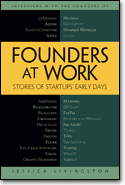 | | Founders at Work There can't be more than a couple thousand people who know first-hand what happens in the first month of a successful startup. Jessica Livingston got them to tell us. So despite the interview format, this is really a how-to book. It is probably the single most valuable book a startup founder could read. |
|